
Where the yield actually is: Dubai’s best areas for rental return — and the risk behind the top numbers
Search for the best area to invest in Dubai and you will find a hundred “top five highest yield” lists, almost all of them selling something. The uncomfortable truth they skip is that the highest yields tend to sit exactly where the risk is highest too. Yield and risk move together here, as everywhere. Here is where the top numbers actually are, why they are high, and what you give up to get them.
Why yield varies so much by area
Gross yield is just annual rent divided by price, so it rises wherever rent stays healthy but the price is low. That describes Dubai’s affordable, apartment-led communities: entry prices are modest, tenant demand is deep, and the ratio looks generous. Prime areas invert it — prices are high relative to rent, so the yield number is lower even though the rent in absolute terms is large. Neither number is “better” on its own; they are measuring different things. The high-yield areas are optimised for income, the prime areas for capital preservation and liquidity, and the right one depends on what you actually want from the money.
The high-yield end: where the top numbers are
The strongest gross yields cluster in the mid-market apartment communities — the newer, well-connected suburban towers and the established affordable districts where studios and one-bedrooms rent readily. Areas of this type (Jumeirah Village Circle, Dubai Sports City, Arjan, Discovery Gardens and International City are frequently cited examples) can show headline yields others cannot. But read the small print: these are the areas most exposed to new supply, where a wave of handovers can soften rents; tenant turnover is higher; and capital growth has historically been slower than in prime. You are buying income, and you are accepting the risks that come with an income-first asset.
The prime end: lower yield, other rewards
At the other end sit the trophy addresses — Palm Jumeirah, Downtown, Dubai Marina, Emaar Beachfront and the like. Their gross yields are lower, often 5-6 percent, because prices are high. What you get for that is different: stronger capital preservation through cycles, deeper liquidity when you sell, better-quality tenants, and the resilience that scarcity and prestige provide. For a buyer whose priority is protecting capital and holding a liquid, desirable asset, a lower yield in prime can be the smarter number than a higher yield in a crowded suburb.
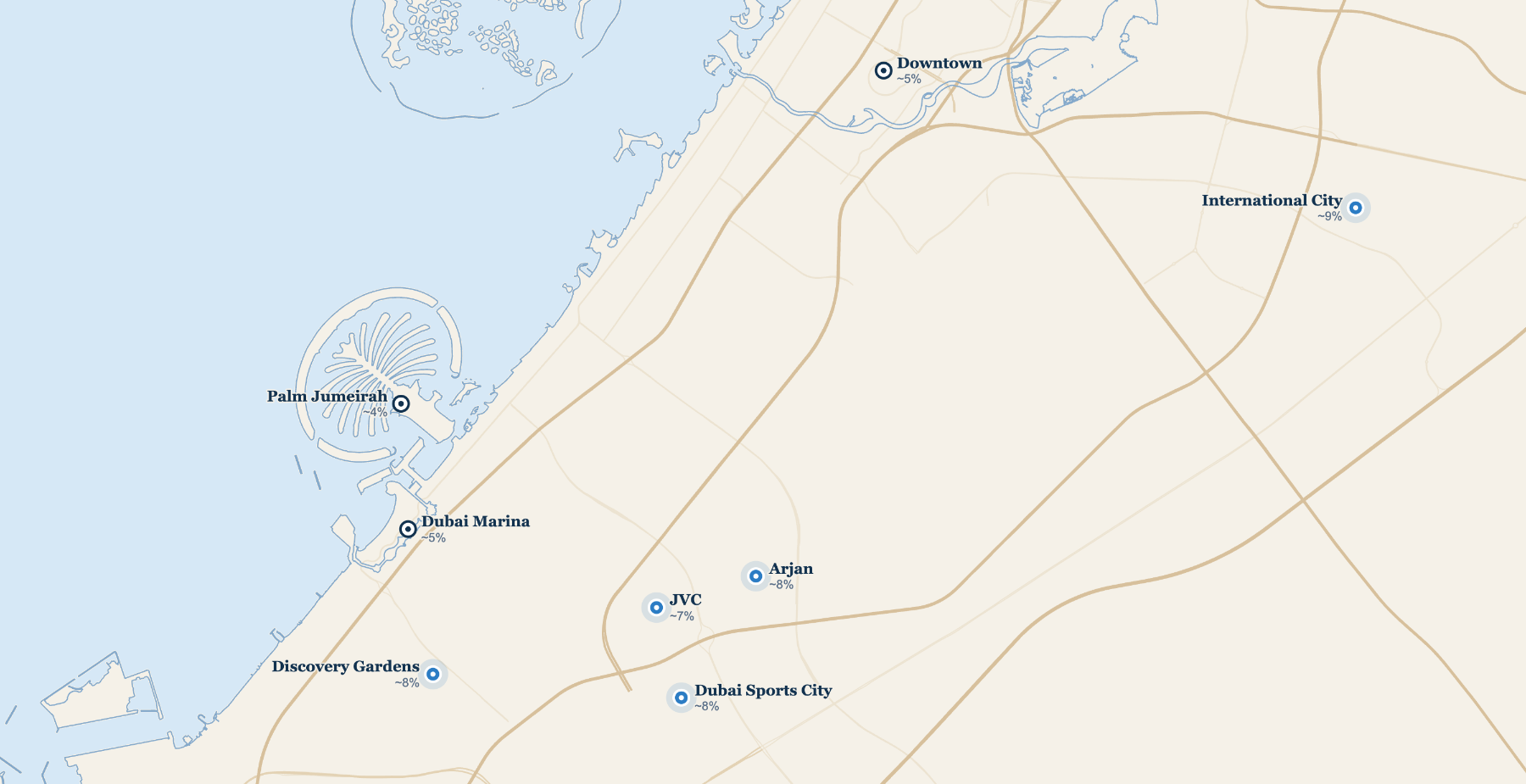
Prime coastal and central addresses trade income for capital preservation; the highest gross yields sit inland, in the more affordable apartment communities. A real map of the areas discussed in this guide.
 Arabian Gulf
Coastline © OpenStreetMap contributors. Markers are approximate area centroids, illustrative of each yield band — not recommendations. Verify current figures with the Dubai Land Department (DLD) and RERA.
Gross is not net — and net varies by area too
The headline number is always gross, and the gap to net differs by exactly the kind of building you buy. Prime, amenity-heavy towers carry higher service charges, which quietly eat into that already-lower gross. Affordable towers charge less, preserving more of a higher gross. Vacancy cuts both ways: deep-demand affordable areas may re-let quickly, while a niche prime unit can sit longer. If you overlay short-let, add the permit and management costs from the holiday-home maths. The point is simple: a 9 percent gross in a high-charge, high-vacancy building can end up below a 6 percent gross in a lean, always-let one.
Yield by area type, at a glance
| Area type | Typical gross yield | The catch |
|---|---|---|
| Affordable apartment communities | ~7-9% | Supply risk, turnover, slower growth |
| Mid-market, well-connected | ~6-7% | Depends heavily on the specific tower |
| Prime waterfront / Downtown | ~5-6% | Lower income, but liquid and resilient |
| Ultra-prime / branded | ~4-5% | Bought for capital and lifestyle, not yield |
Indicative ranges that move with the market and the individual property. Confirm current figures with Dubai Land Department and RERA data before relying on any of them.
How to read a “highest yield” list
Treat the top of any yield ranking as a risk ranking in disguise. The areas with the highest gross are usually the most exposed to new supply and the slowest to appreciate — which can be exactly right if income is your goal and you have priced the risks, and exactly wrong if you assumed the high yield came free. The best area for you is not the one with the biggest headline; it is the one whose blend of net income, growth prospect and risk matches what you are trying to achieve. Chase the number without reading what sits behind it and the number rarely survives contact with reality.
Frequently asked
Questions, answered
Which areas have the highest rental yield in Dubai?
Typically the affordable, apartment-led communities — mid-market and suburban towers where prices are low and tenant demand is deep. Frequently cited examples include Jumeirah Village Circle, Dubai Sports City, Arjan and Discovery Gardens. They can show roughly 7-9% gross, but with more supply and vacancy risk.
Do higher-yield areas give higher returns?
Not necessarily. A higher gross yield often reflects higher risk and slower capital growth. Net yield after service charges and vacancy, plus any appreciation, matters more than the headline gross — a high gross in a crowded, high-charge building can end up below a lower gross elsewhere.
What is a good rental yield in Dubai?
Gross yields commonly range from around 5% in prime areas to 8-9% in affordable ones. What counts as good depends on your goal: income-focused buyers chase the higher end and price the risk, while capital-preservation buyers accept a lower yield in prime for liquidity and resilience.
Are prime areas bad investments because of lower yields?
No. Prime areas trade income for capital preservation, liquidity and resilience through cycles. For a buyer prioritising those, a lower yield in a prime address can outperform a higher yield in a crowded, supply-heavy suburb.